













Archive
12.11.2026


 0
 0
 Touch operator panels Weintek
 Meters-indicators
 Controllers (PID, ON/OFF)
 I/O modules

I/O modules
 Spark protection barrier

Spark protection barrier
 Recorders and archivers

Recorders and archivers
 Meters and converters of electrical network parameters

Meters and converters of electrical network parameters
 Counters, timers, tachometers

Counters, timers, tachometers
 Liquid level indicators and regulators

Liquid level indicators and regulators
 Programmed logical controllers

Programmed logical controllers
 Manual signal transmitters

Manual signal transmitters
 Technological signaling devices

Technological signaling devices
 Power supplies

Power supplies
Codesys PLC controllers
Codesys PLC controllers
 Normalizing converters

Normalizing converters
Galvanic isolation and branching blocks
Galvanic isolation and branching blocks
 Communication interface converters and amplifiers

Communication interface converters and amplifiers
 Analytical instruments

Analytical instruments
 Switching blocks

Switching blocks
Control and protection units
Control and protection units
 GSM communication routers / modems

GSM communication routers / modems
Archive
12.11.2026
Author
Valerii Dykhnilkin, Microl LLC
E-mail: asutp@microl.ua
Using programmable controllers to run drying kilns makes it easy to achieve high-quality drying of timber of the most diverse wood species.
Process automation is an indispensable feature of any modern enterprise. Properly tuned automatic control loops make it possible to produce better products with less money, time and effort. Automation is also partly aimed at reducing the influence of the human factor on the process.
Proper automation of complex processes is hard work for specialized design organizations and a long search for optimal solutions to a number of complex problems. It is simply impossible to cover such issues, even superficially, in a short article. On the other hand, there are processes that seem simple at first glance but have nuances that must be taken into account when developing an automation system. This article is about one of them.
Let us look at one way of automating timber drying with programmable controllers. First, what is "timber drying"? It is the process of removing moisture from wood by evaporation. The specific feature of the process is that the temperature and moisture content of the wood must change according to a certain time schedule, which differs between wood species. Proper kiln operation depends directly on a correctly built step program for humidity and temperature control and on accurate time constants and temperature values used as setpoints for the continuous control loops.
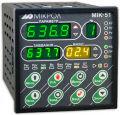
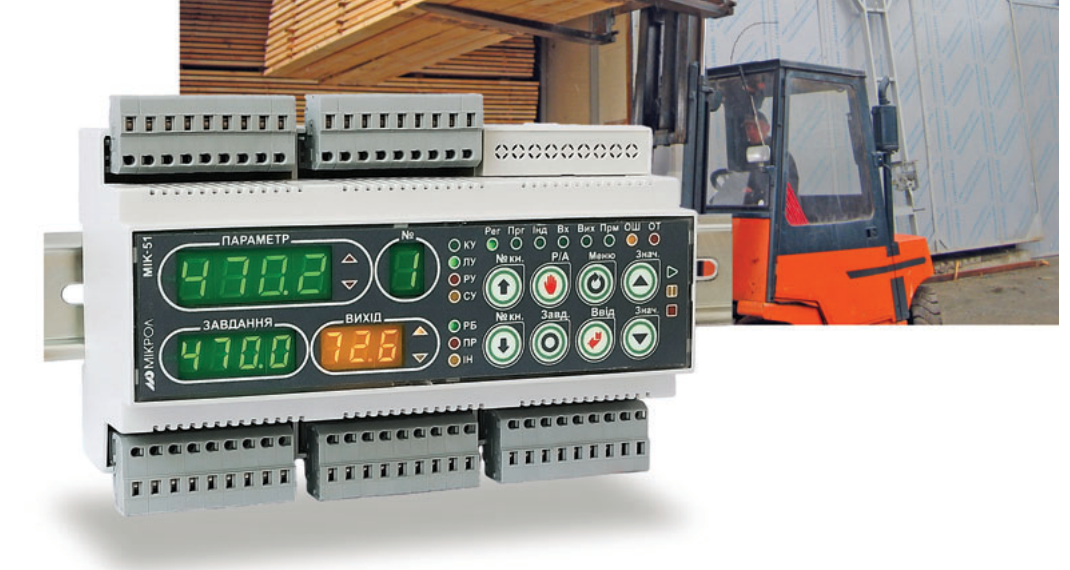
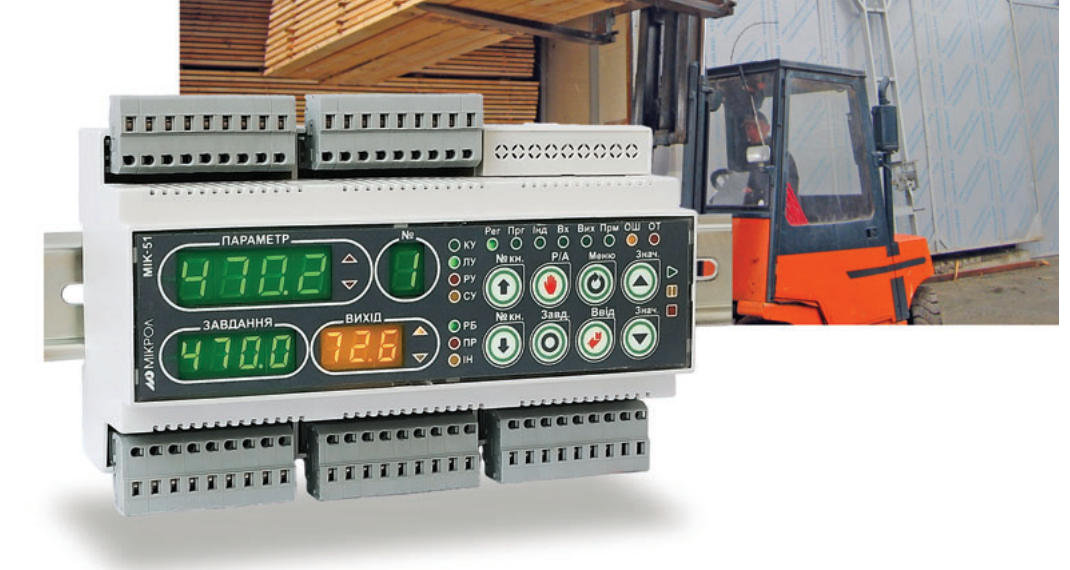
This task can be solved with a programmable controller such as the MIK-51N from Microl (Ivano-Frankivsk). The MIK-51N is a combined device that includes both logic/command control loops and continuous control loops. MIK-51N controllers also have an advanced inter-controller communication system that allows them to be combined into a local or distributed control network. This makes distributed data processing possible and increases the number of I/O channels.
Kiln temperature is measured by sensors connected to the controller's first and second analog inputs. These can be TSM, TSP, TSMU or TSPU resistance temperature sensors. From their readings, the device calculates the humidity in the kiln.
Motorized valves (MEO actuators) are provided on the lines supplying hot steam to the steam heater and steam for humidification. A similar drive moves the damper on the line that vents humid air from the kiln.
The MIK-51N receives information on the moisture content of the wood itself from sensors connected to the third (AI3) and fourth (AI4) analog inputs. Kiln temperature is controlled by supplying hot steam through the steam heater (controller digital outputs DO3 and DO4 → MEO actuator → control valve on the hot steam line). Kiln humidity is controlled by injecting humidification steam (digital outputs DO1 and DO2) or by the opening of the humid air vent damper (digital outputs DO5 and DO6).
Fans provide constant or periodic air circulation to heat the kiln quickly and even out the temperature at different points. The fans are controlled by the controller's digital outputs DO7 and DO8.
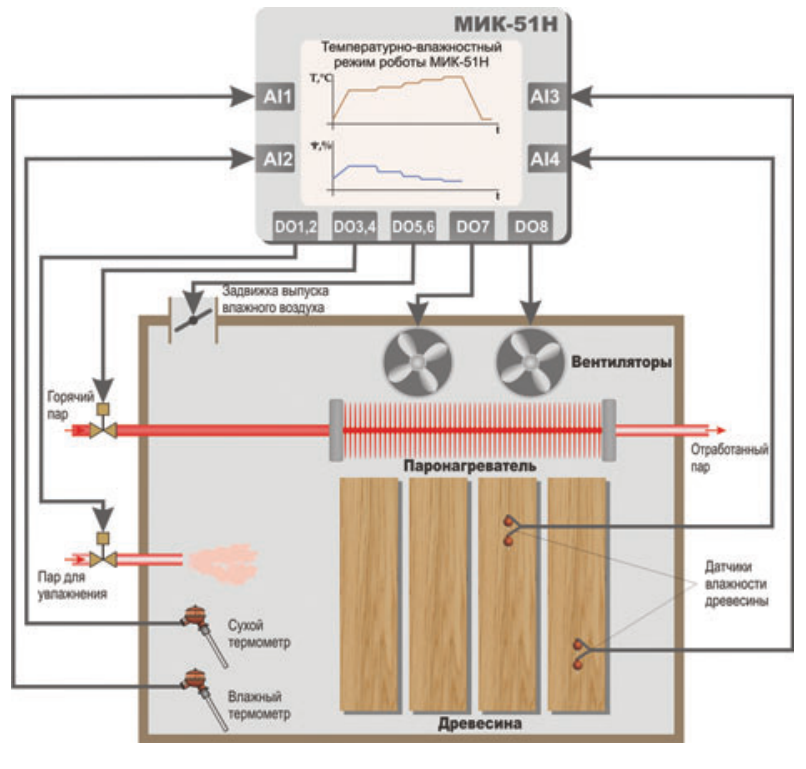
Fig. 1. Timber drying control system
The MIK-51N timber drying program is quite large (about fifty FBD blocks), so it is not described in full here. At the time of publication, the program itself and a sample operator workstation for the drying unit based on the Visual Intellect SCADA system could be downloaded from the Microl website, in the section with sample solutions for typical process automation tasks. Current software is available in the Software section at www.microl.ua.
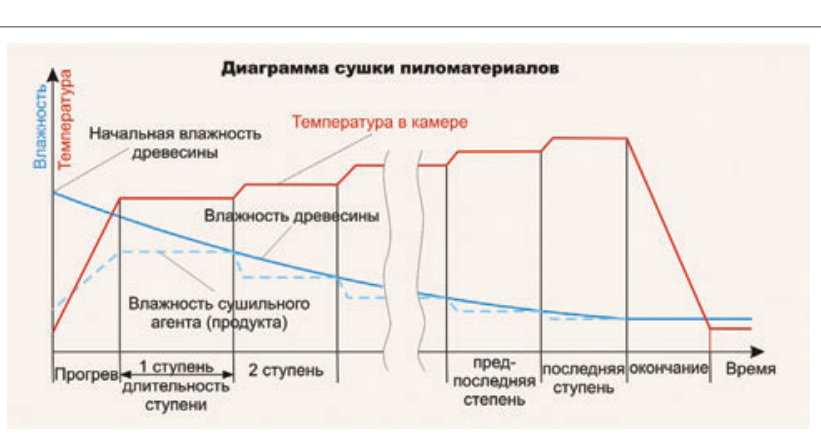
Fig. 2. Humidity and temperature profile
To implement the time schedule for wood moisture and kiln temperature, the FBD program uses the TM_PRG(57) program setpoint generator function block, whose structure is shown in Fig. 3. This block implements a piecewise-linear function of time consisting of several (up to 48) segments. To build them, the setpoint generator uses constants stored in multichannel time setpoint blocks (TM_M(56)) and analog setpoint blocks (SP_M(54)) (Fig. 4).
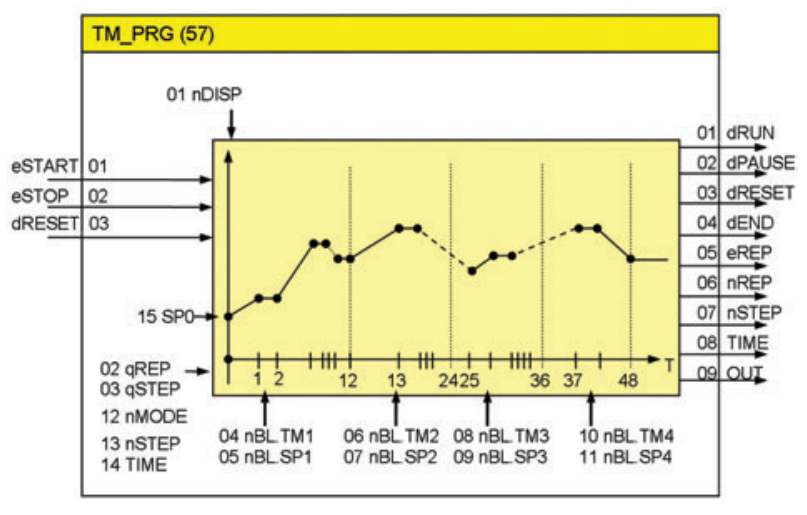
Fig. 3. Functional diagram of the program setpoint generator block
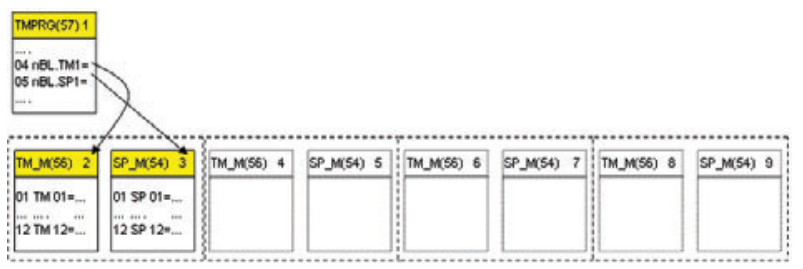
Fig. 4. Using the TM_PRG(57) setpoint generator with TM_M and SP_M
The user decides how many function blocks are needed, bearing in mind that one TM_M(56) and SP_M(54) pair can define up to 12 segments. So to define 36 segments, three TM_M(56) and SP_M(54) pairs are used, and their sequence numbers are entered in the TM_PRG(57) block. Up to four pairs of these blocks can be connected.
Since the setpoint blocks are addressed directly by the setpoint generator, their outputs do not need to be connected. The MIK-51N front panel has dedicated indicators that show the state of the setpoint generator ("Running", "Waiting/Paused" and "Stop/End of program").
Note that drying schedules for sawn timber and wood blanks in batch-type steam-air drying kilns are defined by the interstate standard GOST 19773-84. It contains all the tabular data needed to adjust the controller program. Incidentally, several program setpoint generator blocks can be used in one FBD program to create a MIK-51N control program with a choice of kiln operating modes. This in turn makes it possible to switch the kiln to a different type of wood with a few presses of the controller's front-panel keys.
The use of program setpoint generator blocks in MIK-51N programs is by no means limited to timber drying. The ability to program temperature changes over time is used in many industries — for example, in baking bread and bakery products, in canning, in step (or hot) quenching of steel, in gradual heating of columns at chemical plants, and so on.
For more information about the products mentioned in this article, please contact Microl LLC:
+38 (0342) 502-701
+38 (067) 359-70-90
+38 (095) 092-07-28
sale@microl.ua, microl_zbut@microl.ua, zbutmicrol@gmail.com
www.microl.ua
Technical support:
+38 (0342) 502-702
+38 (067) 704-00-29
+38 (095) 302-37-57
support@microl.ua, supmicrol@gmail.com
Originally published in Mir Avtomatizatsii (World of Automation) magazine, February–April 2009.
Open the booklet / download PDF