


















Archive
10.11.2026


 0
 0
 Touch operator panels Weintek
 Meters-indicators
 Controllers (PID, ON/OFF)
 I/O modules

I/O modules
 Spark protection barrier

Spark protection barrier
 Recorders and archivers

Recorders and archivers
 Meters and converters of electrical network parameters

Meters and converters of electrical network parameters
 Counters, timers, tachometers

Counters, timers, tachometers
 Liquid level indicators and regulators

Liquid level indicators and regulators
 Programmed logical controllers

Programmed logical controllers
 Manual signal transmitters

Manual signal transmitters
 Technological signaling devices

Technological signaling devices
 Power supplies

Power supplies
Codesys PLC controllers
Codesys PLC controllers
 Normalizing converters

Normalizing converters
Galvanic isolation and branching blocks
Galvanic isolation and branching blocks
 Communication interface converters and amplifiers

Communication interface converters and amplifiers
 Analytical instruments

Analytical instruments
 Switching blocks

Switching blocks
Control and protection units
Control and protection units
 GSM communication routers / modems

GSM communication routers / modems
Archive
10.11.2026
Author
Yurii Tverskoi, PhD
E-mail: termokip@mail.ru
Modern automation equipment makes it possible to re-equip small and medium-capacity boiler plants with quality, in stages and economically.
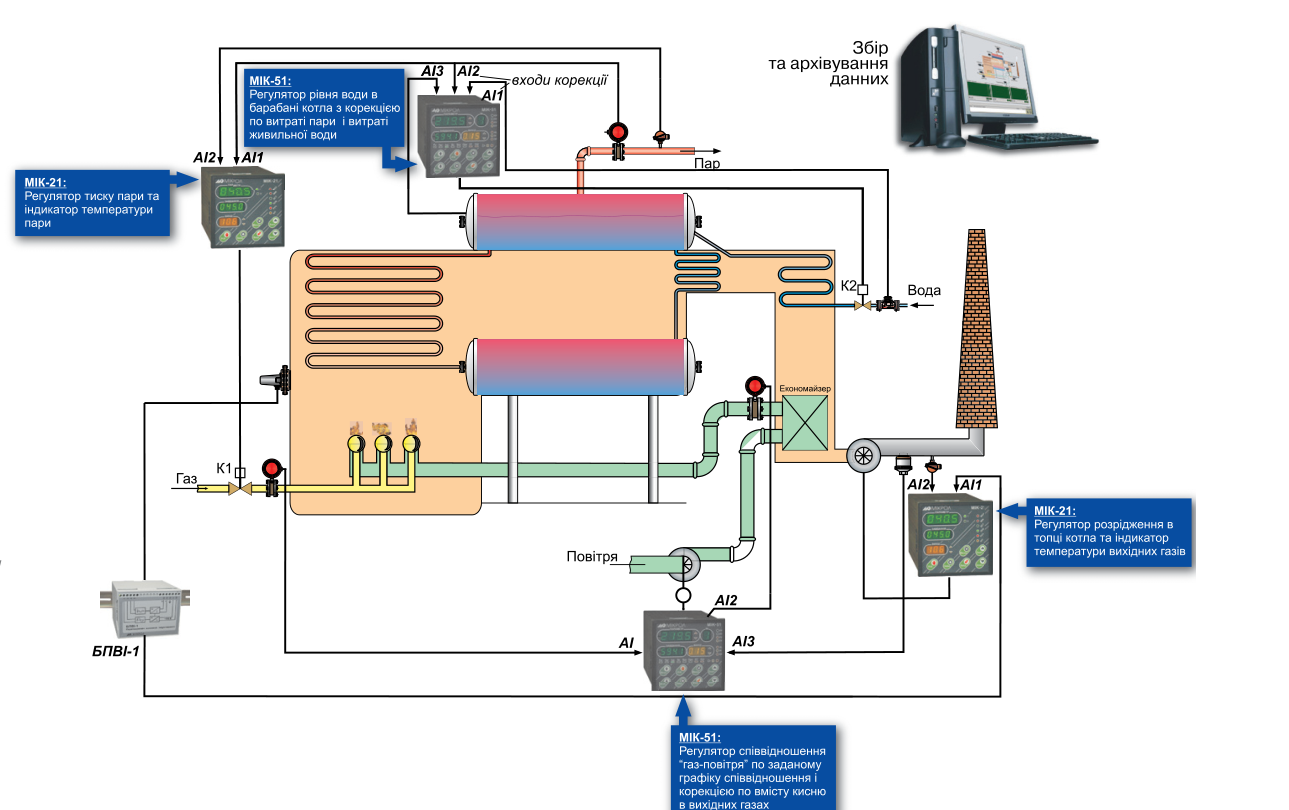
Automation diagram of a DKVR-20 boiler
Any investment in the technical re-equipment of an industrial enterprise is expected to generate profit. While the move to more advanced technology makes economic and technical sense to any owner or manager, the financial returns from investing in automation based on more advanced control equipment are less obvious in the "dividends" column. Automation engineers have a saying: "if automating a process increases profit by more than 5 %, change the process." That is why it is not easy to persuade an owner to replace 20-year-old automation equipment with new. So commissioning engineers — at boiler houses, for example — run around markets and small firms with a few coins in their pockets, looking for surplus or even second-hand parts to somehow "patch the holes" and get through the inevitably approaching heating season.
Let us look at what new automation brings, using a boiler unit as an example. Almost every enterprise has a boiler house, which means that the cost of producing steam is built into the cost of its products. For heat and power generating companies, steam and electricity produced by steam turbines are the end product.
In large-scale heat power engineering, people fully understand the importance of moving to more advanced automation (they are brought up on the "W"/specific reference-fuel consumption per unit of electricity generated indicator) — to confirm this, just visit the websites of SCADA vendors and look at their latest news. In small and medium-scale heat power engineering, everything just drifts with the current, except for a few advanced companies, usually food and beverage bottling plants.
As an example, let us take the following starting point: a typical enterprise boiler house with 3–5 boilers, such as the DKVR-20. Its classic, time-tested automation structure consists of four control loops: steam pressure (load), boiler drum level, gas/air ratio and furnace draft.
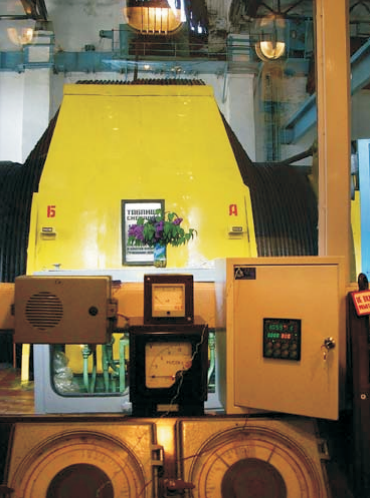
The automation here is based on MZTA instruments from the 1980s: R25.1.2 controllers (RPIB units can still be found too) or RS29.1.12 (UKR01.1.12), MEO actuators of various ratings, primary sensors with differential-transformer outputs (DM3583, DT-2-50), and recorders such as the KSD2-056, -003, or even the DSS-712 (711). Plus the staff: a "jack-of-all-trades" commissioning engineer and operators "Aunt Masha" and "Uncle Vanya" — exceptionally conscientious workers, but extremely conservative in their views and actions. And, of course, the head of the boiler house, who is effectively on the front line. Incidentally, all staff working with such instruments could be nominated for a "For Courage in the Boiler Room" award in the period between repairs (during the rest of the year there is no time to receive awards).
Patching up boiler houses by replacing failed instruments is not that cheap either, since the surplus-stock market is also subject to inflation. For example, an R25.1.2 already costs about UAH 700, regardless of whether its capacitors and other electronic components are still alive.
By giving in to the temptation to hold out on old instruments for another year, the management of such boiler houses not only postpones a brighter future, but also puts at risk the health of staff working with completely worn-out equipment on high-hazard units such as boilers, not to mention the process equipment itself. Of course, a forward-thinking owner would like to start afresh: throw out all the old instruments, buy Metran transmitters and Siemens controllers, and replace the MEO actuators with variable frequency drives. Then install an industrial computer, and everything will work out by itself. However, as we know, nothing works out at once — but you can easily fall into the hands of an inexperienced system integrator with often temperamental programmers.
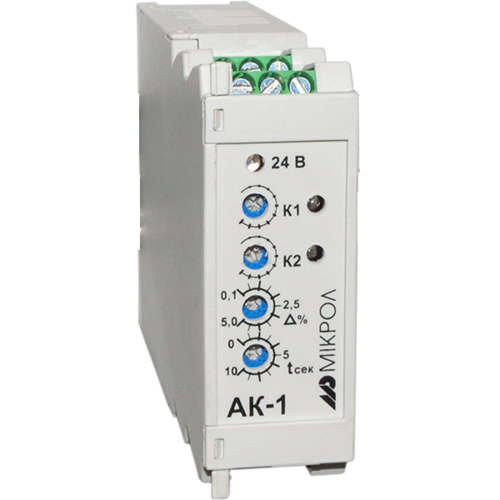
As an alternative to revolutionary change, we propose a rational, step-by-step strategy for re-equipping a boiler house using inexpensive microprocessor controllers, for example from the Ukrainian company Microl — less costly both upfront and over time. First of all, we replace the heart of the control loop with a MIK-21 PID controller or a MIK-51 controller (see Mir Avtomatizatsii No. 2, 2008, for more details on the latter). At the first stage, the old sensors with differential-transformer outputs can be kept by using a BPVI-1 converter. The MEO actuators stay in place too.
A MIK-51 makes it possible to implement the classic three-element boiler drum level control scheme, and another MIK-51 in the fuel/air ratio loop implements a nonlinear load curve, since the excess air ratio has never been linearly related to boiler load. MIK-21 controllers can be installed in the pressure and draft loops. It might seem that everything is the same as in the old scheme, just with new instruments. But once you study the specifications of Microl instruments carefully, you realize that you have created a foundation for further improving the control system, both in terms of algorithms and hardware.
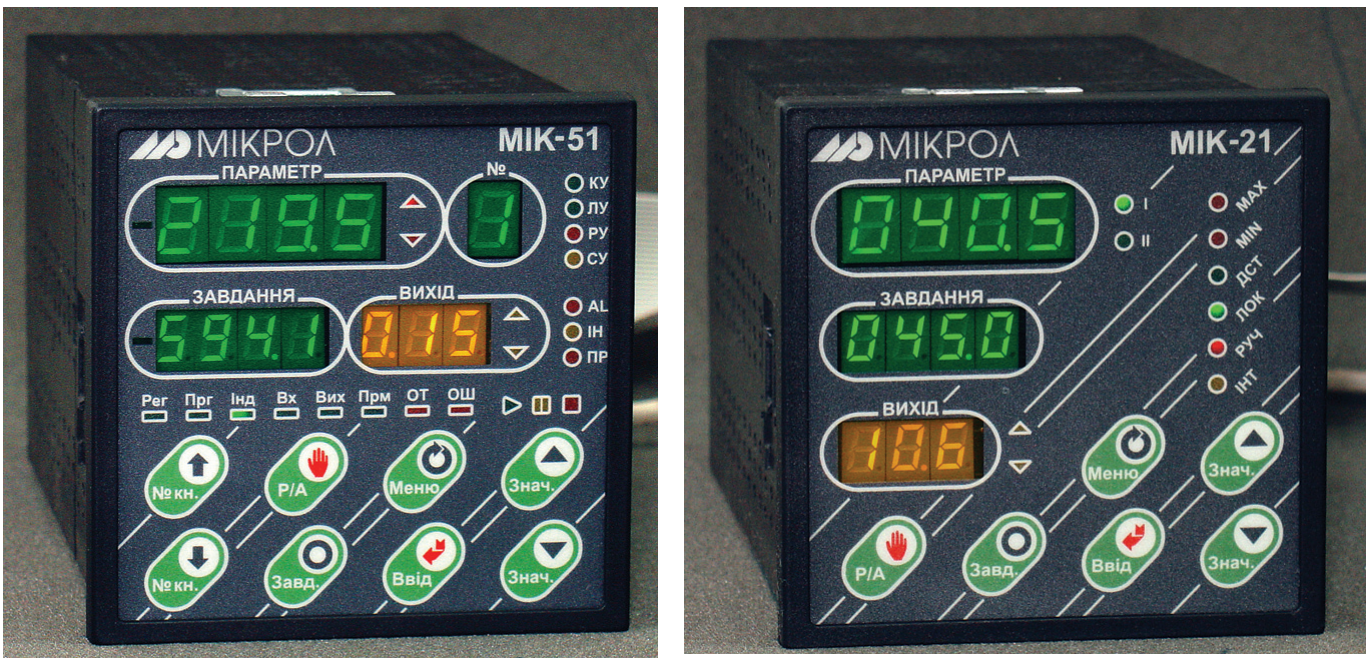
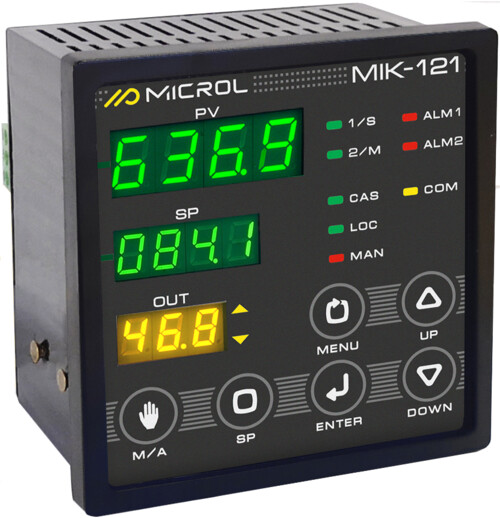
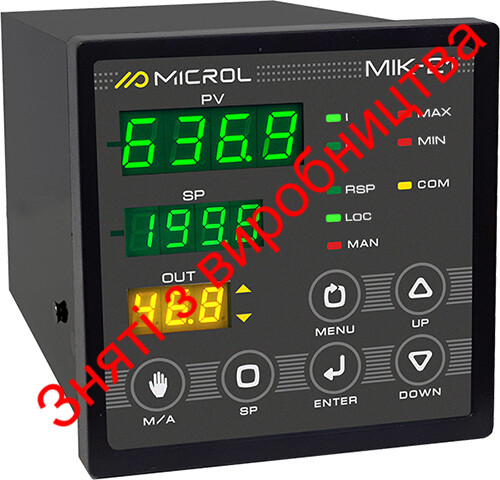
Fig. 1. The flexible internal structure and easily recalibrated inputs/outputs of MIK-21 controllers (right) and MIK-51 PLCs (left) make it easy to adapt the hardware to a specific controlled object
First, the same control cabinet can be used with minor modifications. Since MIK controllers offer both pulse and analog control functions as well as advanced PID algorithms, either MEO actuators or variable frequency drives (instead of MEO) can be used as final control elements, which directly delivers an economic effect (for example, in draft and/or air supply control).
Second, the 16-bit ADC in MIK controllers makes it worthwhile to buy high-accuracy pressure and differential pressure (flow) transmitters, such as Metran. In the old system, using a Metran was like fitting fancy wheels on a Zaporozhets. It is important to note that digital inputs/outputs allow the controllers to take on alarm and protection functions, and communication functions (RS-485 Modbus RTU, OPC server) make it easy to integrate Microl instruments into any SCADA-type visualization and archiving software, including Microl's own free software, and to provide continuous process monitoring.
Third, the entire re-equipment can be carried out in-house (remember the jack-of-all-trades engineer), without hiring outside companies. MIK-21 configurations and MIK-51 user programs for boiler control can be downloaded from the controller manufacturer's website. Not even a screwdriver is needed during installation, since the terminal block connectors use WAGO-type spring terminals, and complete technical documentation easily turns a seemingly complex device into the best friend of the commissioning engineer and operator. Sensors (for example, flue gas temperature sensors) can be connected to the MIK-51 analog inputs left free in the control loops.
Finally, "Aunt Masha" and "Uncle Vanya" will be happy too, because the MIK controller front panels have the familiar "Manual", "Auto" and "Setpoint" buttons, and an experienced engineer can also limit their initiative by restricting parameter changes. Thus, the flexible internal structure and easily recalibrated inputs/outputs of MIK-21 controllers and MIK-51 PLCs make it possible to adapt the hardware quickly to a specific controlled object.
As mentioned above, when calculating the economic effect it is incorrect to talk about figures above 5 %, except in special cases where more modern automation makes it possible to use a more advanced technology (for example, variable frequency drives).
A one-sided approach is unacceptable when assessing the economic effect of introducing a more advanced control system. It is a broad concept: for example, by reducing the variance of the controlled variable and keeping all boiler unit parameters in the required proportions depending on load, we extend the time between repairs and thus reduce the number of repairs and their total cost. But even economists will struggle to say what monetary value to put on improved operational safety and better working conditions for staff.
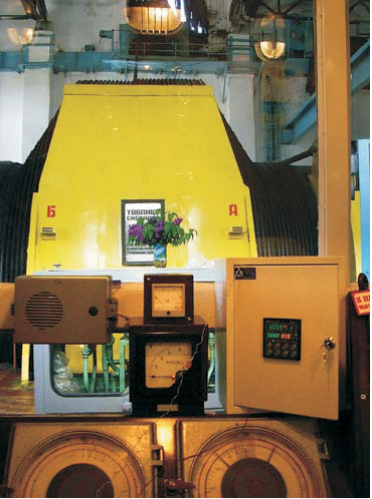
Boiler plant upgrade and re-equipment solutions are successfully operating at many plants in Ukraine
The financial benefit of introducing modern automation as described here, using a boiler house as an example, lies in following the right investment strategy. The rational path is to introduce new equipment step by step, based on controllers from a company such as Microl, within the time-tested structure of control loops. Subsequent additions — more advanced analog and discrete sensors, actuators and control algorithms — will no longer require the same investment as the heart of the system.
The boiler plant upgrade and re-equipment solution described in this article, based on Microl automation equipment, has been designed, implemented and is successfully operating at the Kremenchuk CHP Plant, the Kharkiv CHP Plant, on the steam boilers of the Ilyich Iron and Steel Works and at many other plants in Ukraine. In addition, a project to automate power unit No. 4 of the Kurakhove power plant is currently being implemented on MIK-51 controllers.
At the time of publication, MIK-51 programs, MIK-21 configurations and a VisualIntellect SCADA project for a boiler plant (gas–air ratio, drum water level, draft and steam pressure control, plus a boiler house SCADA) were available for download from the manufacturer's website. Current software is available in the Software section at www.microl.ua.
For more information about the products mentioned in this article, please contact Microl LLC:
+38 (0342) 502-701
+38 (067) 359-70-90
+38 (095) 092-07-28
sale@microl.ua, microl_zbut@microl.ua, zbutmicrol@gmail.com
www.microl.ua
Technical support:
+38 (0342) 502-702
+38 (067) 704-00-29
+38 (095) 302-37-57
support@microl.ua, supmicrol@gmail.com
Originally published in Mir Avtomatizatsii (World of Automation) magazine, August 2008.
Open the booklet / download PDF