







Archive
10.11.2026


 0
 0
 Touch operator panels Weintek
 Meters-indicators
 Controllers (PID, ON/OFF)
 I/O modules

I/O modules
 Spark protection barrier

Spark protection barrier
 Recorders and archivers

Recorders and archivers
 Meters and converters of electrical network parameters

Meters and converters of electrical network parameters
 Counters, timers, tachometers

Counters, timers, tachometers
 Liquid level indicators and regulators

Liquid level indicators and regulators
 Programmed logical controllers

Programmed logical controllers
 Manual signal transmitters

Manual signal transmitters
 Technological signaling devices

Technological signaling devices
 Power supplies

Power supplies
Codesys PLC controllers
Codesys PLC controllers
 Normalizing converters

Normalizing converters
Galvanic isolation and branching blocks
Galvanic isolation and branching blocks
 Communication interface converters and amplifiers

Communication interface converters and amplifiers
 Analytical instruments

Analytical instruments
 Switching blocks

Switching blocks
Control and protection units
Control and protection units
 GSM communication routers / modems

GSM communication routers / modems
Archive
10.11.2026
Author
Yurii Tverskoi, PhD
E-mail: termokip@mail.ru
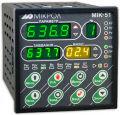
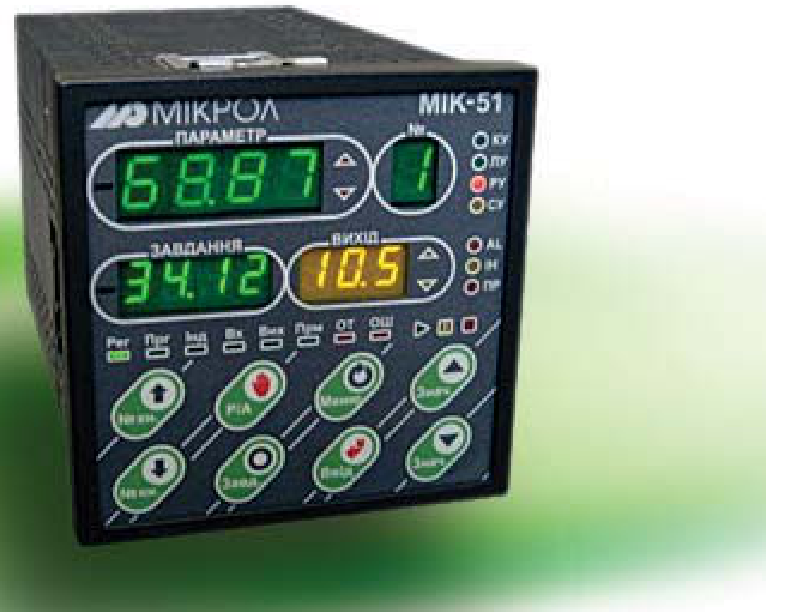
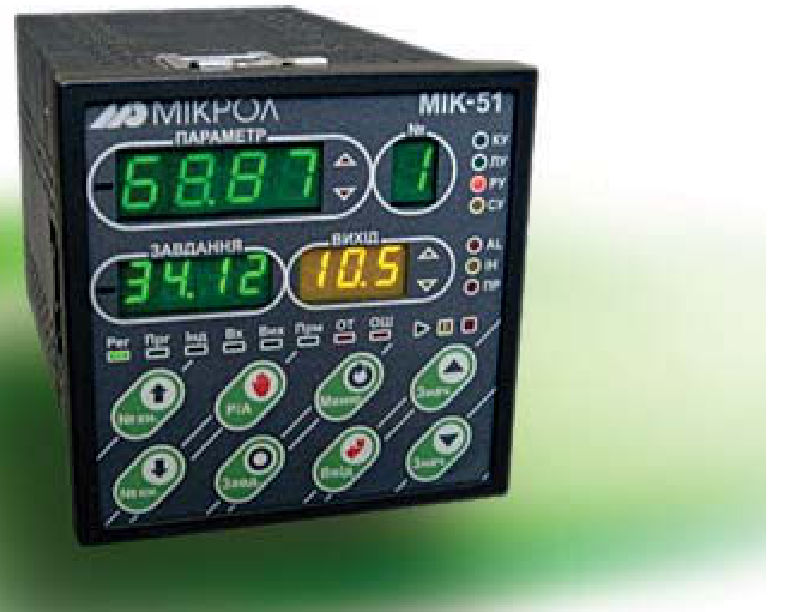
The MIK-51 compact controller is used to solve complex process automation tasks at power, chemical, food and other industrial enterprises both in Ukraine and abroad.
A market, as an economic category, is based on the "manufacturer – consumer" chain interacting with a "bourgeois layer" in the form of a trading company. The industrial automation market also needs a "proletariat" in the form of an engineering company — the system integrator. All market participants, united by the common goal of maximizing profit, secretly dream of making life easier on their way to prosperity.
The manufacturer would like to produce one device for every occasion: universal inputs/outputs, auto-tuning, freely programmable "hardware intelligence" and so on. The consumer wants a specific device for a specific object, without redundant hardware and software, with an "eternal" warranty and an "eternal" service life — right up to a revolutionary change in technology.
Traders are, in principle, happy with the manufacturer's utopian dreams, since they could then calmly stock up on identical devices and not have to "scratch their heads" before every new delivery over whether thermocouple inputs or RTD inputs will be in demand this time. The system integrator does not mind what it works with, but a freely programmable controller does let it fully demonstrate its expertise within the technical specification and rightfully earn its fee.
Paradoxical as it may sound, a freely programmable controller has practically no consumer value on its own. Even after buying it, or receiving the bundled software free of charge, the average user cannot put it into operation straight away. Someone else — a system integrator, for example — gives the controller its real final value. And then it becomes a question of price.
The market, as a feedback system, balances the different aspirations of participants united by the common goal of making a profit. As a result, ranges of controllers with varying degrees of freedom in reconfiguring their inputs/outputs and internal structure appear on the market. The reliability of distributed control systems, proven in practice, led to the appearance of so-called compact (low channel count) controllers. Industrial processes include many individual objects or sections of a production line that can be fully automated with such controllers, including start-up and shutdown modes — that is, both continuous "analog" control and programmed "discrete" logic control tasks.
As an example, let us look at the Ukrainian-made MIK-51 controller produced by Microl. Depending on the configuration ordered, the controller can have 4 analog inputs (4AI), up to 19 digital inputs (19DI), up to 4 analog outputs (4AO) and up to 21 digital outputs (21DO).
It is programmed with a free software package — the ALFA FBD program editor (Fig. 1), which provides object-based visual programming in the Function Block Diagram language. The editor's main purpose is to provide the most convenient interactive programming environment for MIK-51 microprocessor controllers.
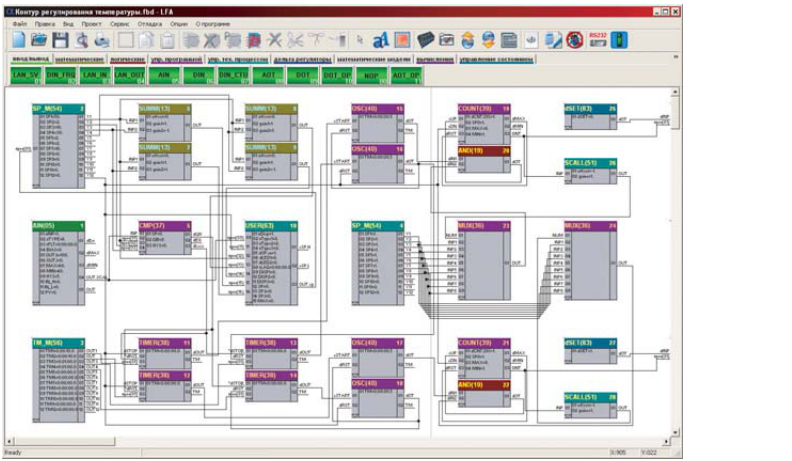
Fig. 1. Sample program in the ALFA editor
ALFA's user interface is quite close to common office software. It uses the same working methods, the usual keyboard shortcuts for routine operations and the familiar layout of toolbars and buttons. As a result, the new program is mastered very quickly.
Note that the popular FBD language is intended for automation engineers, but the level of detail differs from one controller to another. A block in the ALFA editor is practically a self-contained virtual instrument/converter. In the end, programming effectively comes down to design! For example, once you place an analog input module, it is immediately "tied" to a real hardware input, and the block itself offers a full set of signal processing functions: filtering, offset, alarm limits, calibration and so on.
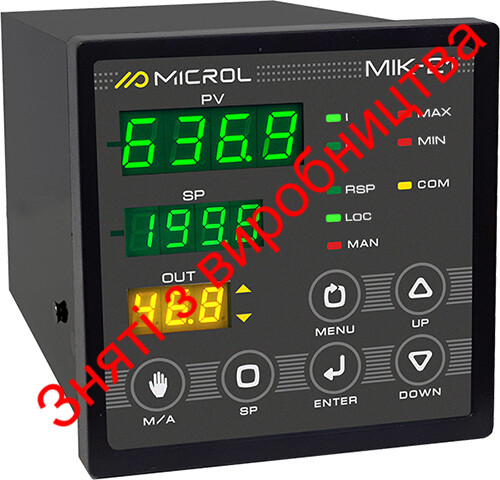
The PID controller block is not just a PID formula, but a virtual counterpart of a real modern hardware PID controller with the corresponding set of tuning parameters. Conveniently, the PID function block placed in a program is automatically linked to the front-panel buttons "M/A" (Manual/Auto) and "Setpoint" and to the "Parameter", "Setpoint" and "Output" displays (Fig. 2).
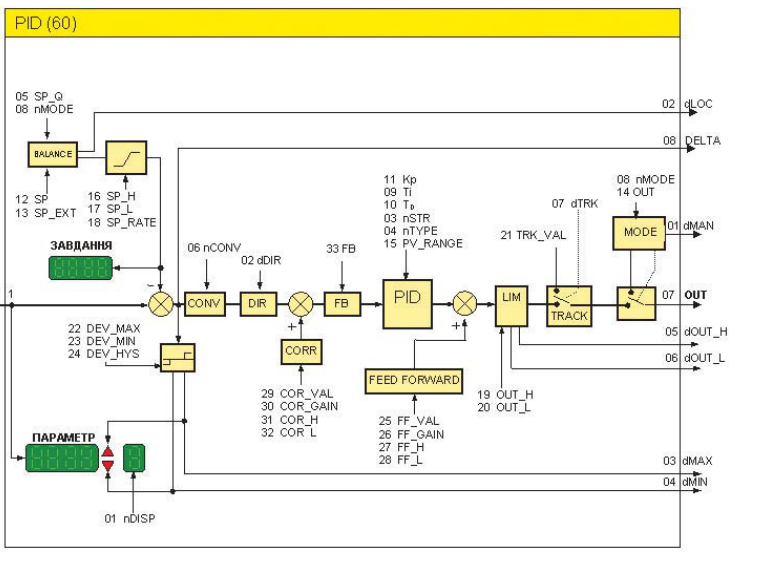
Fig. 2. Internal structure of the PID controller block
The MIK-51 function block library currently contains 88 algorithm blocks, and the number keeps growing. The function blocks cover practically every area of continuous control, logic control, process alarms, interlocks and protection, which makes it possible to integrate the controller into any existing automatic control system.
First of all, there are the input/output function blocks (analog, digital and pulse), which act as a bridge between real process variables and the controller's internal structure. If a control loop involves several MIK-51 units, the library also includes interface I/O blocks that let controllers exchange data with each other over an RS-485 bus without a computer as an intermediary.
Also worth mentioning are the function blocks for mathematical operations (including logarithms and exponents) and logic operations (from elementary logic functions to comparators, counters, registers and flip-flops), time-based blocks (timers, one-shots, multivibrators) and process control blocks. Controller blocks (analog, pulse and PID-PWM controllers) for building a wide variety of control systems are included too.
All classic control schemes — feedback, feedforward, combined, cascade, multivariable, "with a decaying signal from an intermediate variable" and so on — are easy to design in the ALFA editor. The program setpoint generator makes it possible to implement step-by-step process control, for example with different temperature profiles at different stages. Real-time clock timers allow control algorithms to be tied to calendar time.
It is impossible to describe all the potential capabilities of the MIK-51 in a single article, so we will focus on just a few.
The basic MIK-51-00 model (4AI, 3DI, 5DO, 1AO) can run several control loops. For example, a PID-PWM controller with one digital output for controlling a "heater"/"cooler" (an FBD program built in the ALFA editor is shown in Fig. 3).
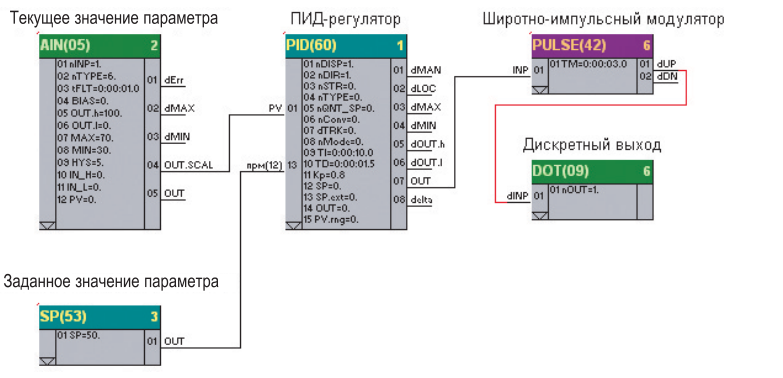
Fig. 3. Sample PID-PWM controller
A pulse PID controller with two digital outputs, "More" and "Less", for controlling constant-speed actuators or variable frequency drives (Fig. 4).
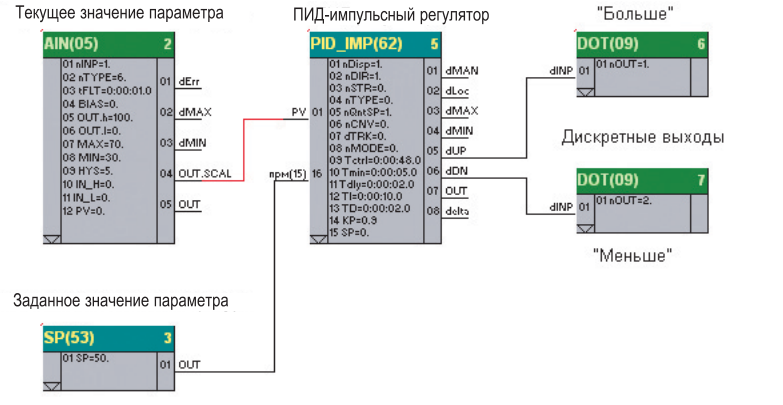
Fig. 4. Sample pulse PID controller
An analog PID controller with an analog output to a variable frequency drive or an analog actuator (Fig. 5). If necessary, the MR-51-07 analog output expansion module can be added to run three more analog PID controllers.
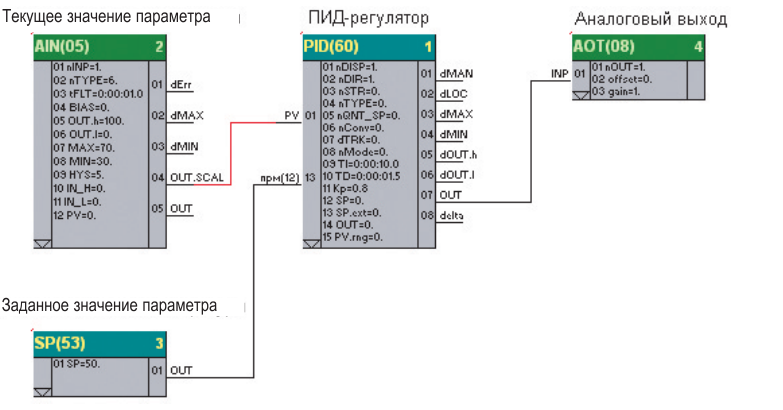
Fig. 5. Sample analog PID controller
It should be noted that the MIK-51 is not limited to continuous control loops. Its function block library also includes the STEP block, which is used to build step programs — a defined sequence of actions.
Combined with ALFA blocks, the set of expansion modules covers a wide range of programmed logic control tasks, in particular start-up and shutdown of process equipment, emergency protection and alarms.
Thanks to its structure, the compact MIK-51 is ideal for weather-compensated heating and hot water controllers. Cheaper domestically made temperature sensors can be used, and the control algorithm is easily adapted to a given heating system layout (for example, with two circulation pumps, one, or none at all). With the heating and hot water flow diagram and the structure of a weather-compensated controller (for example, Danfoss ECL), you can quickly build a clone of the algorithm in the ALFA editor.
Carbon black producers should also take a look at the MIK-51. A carbon black reactor usually has gas and air flow stabilization loops with correction for the reaction zone temperature, and a demineralized water supply loop with correction for the quench zone temperature. With several process lines (each line may have 2 to 8 reactors), hardware costs can be reduced while keeping an optimal degree of distribution: each reactor gets its own MIK-51 running a standard control algorithm. Small and medium-scale heat power engineering was covered in Mir Avtomatizatsii No. 4/2008, pp. 58–60.
Thus, the MIK-51 can be the main control device for an object with a small number of loops. If necessary, the system can be supplemented with MIK-21/22/25 PID controllers. In addition, thanks to its advanced communication functions, up to and including GPRS, the MIK-51 can be a full participant in a complex control system built from heterogeneous automation hardware.
We mentioned the consumer price of controllers earlier. Simple, accessible software makes it possible to reduce system integrator costs to zero if the controller is programmed in-house.
Ultimately, the MIK-51 is a product that combines two opposites: versatility on the one hand and ease of configuration on the other. As already mentioned, the ALFA editor is easy to learn. It is not just a program editor for the MIK-51, but a kind of construction kit for building control programs without writing a single line of code.
Today, MIK-51 controllers are already used to solve complex process automation tasks at power, chemical, food and other industrial enterprises both in Ukraine and abroad.
For more information about the products mentioned in this article, please contact Microl LLC:
+38 (0342) 502-701
+38 (067) 359-70-90
+38 (095) 092-07-28
sale@microl.ua, microl_zbut@microl.ua, zbutmicrol@gmail.com
www.microl.ua
Technical support:
+38 (0342) 502-702
+38 (067) 704-00-29
+38 (095) 302-37-57
support@microl.ua, supmicrol@gmail.com
Originally published in Mir Avtomatizatsii (World of Automation) magazine, October 2008.
Open the booklet / download PDF