





































Archive
10.11.2026


 0
 0
 Touch operator panels Weintek
 Meters-indicators
 Controllers (PID, ON/OFF)
 I/O modules

I/O modules
 Spark protection barrier

Spark protection barrier
 Recorders and archivers

Recorders and archivers
 Meters and converters of electrical network parameters

Meters and converters of electrical network parameters
 Counters, timers, tachometers

Counters, timers, tachometers
 Liquid level indicators and regulators

Liquid level indicators and regulators
 Programmed logical controllers

Programmed logical controllers
 Manual signal transmitters

Manual signal transmitters
 Technological signaling devices

Technological signaling devices
 Power supplies

Power supplies
Codesys PLC controllers
Codesys PLC controllers
 Normalizing converters

Normalizing converters
Galvanic isolation and branching blocks
Galvanic isolation and branching blocks
 Communication interface converters and amplifiers

Communication interface converters and amplifiers
 Analytical instruments

Analytical instruments
 Switching blocks

Switching blocks
Control and protection units
Control and protection units
 GSM communication routers / modems

GSM communication routers / modems
Archive
10.11.2026
Author
A. V. Slobodian
E-mail: arny4work@ukr.net
An improved system for monitoring gas temperature upstream of the high-pressure turbine of a GTK-10 gas compressor unit gives operating personnel additional information on GCU dynamics and helps avoid emergency shutdowns.
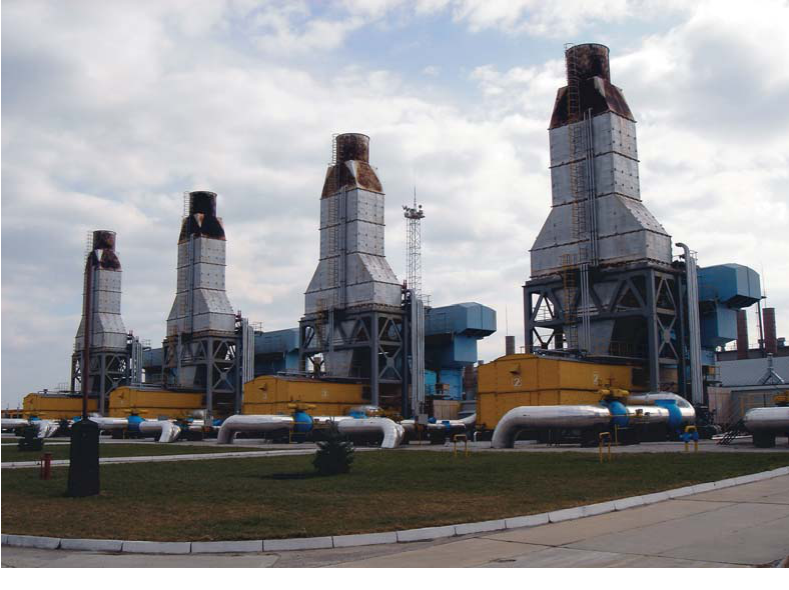
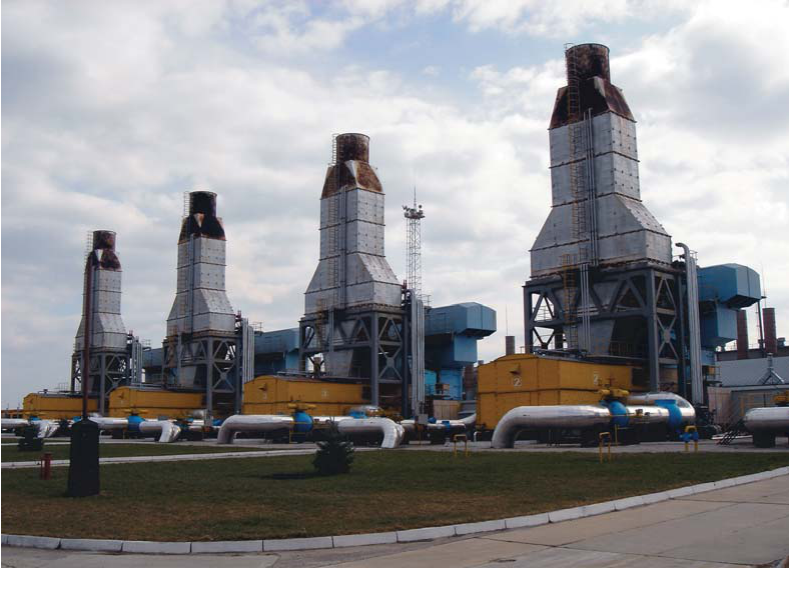
Ukraine's ability to meet its natural gas transit obligations depends directly on the reliable operation of its gas transmission system, so achieving high reliability of gas compressor units (GCUs) is an important task. A GCU moves gas by compressing it. A GCU is a complex, high-hazard facility with a large number of process parameters, so it is operated by an automatic control system (ACS).
An important part of the GCU ACS is the emergency protection system, whose reliability in an emergency determines whether expensive equipment is protected. The system must also prevent GCU emergency shutdowns caused by faulty measurement channels or other false interpretations of process parameters.
Developing methods for predicting pre-emergency and emergency GCU operating modes is an urgent task, since such methods save considerable money on equipment repairs and improve the stability of the gas transmission system as a whole. Automatic analysis of process parameter dynamics over time makes it possible to detect when an individual GCU component is trending towards failure and to prevent it through preventive maintenance. Methods for predicting abnormal situations have a wide range of applications, especially in control systems for high-hazard process facilities.
An analysis of recent research and publications shows that this problem has not been fully solved, because new ACS designs focus mainly on hardware — that is, on how to measure a signal as accurately and as frequently as possible, store it in an archive and pass it to another automation level. The equally important question of applying modern signal analysis algorithms has received too little attention. Typically, an ACS implements classic control and emergency protection loops, whereas controllers are also capable of analyzing the relationships between process parameters, their influence on each other and on the process as a whole. This makes it possible to create an ACS with a qualitatively new level of functionality.
A concrete example of this problem is the analysis of gas temperature upstream of the high-pressure turbine of a GTK (GTNR)-10 GCU. The weak point of the SCKU-type GCU control system is its temperature monitoring subsystems. They include KSM2 instruments for monitoring turbine and compressor bearing temperatures and KSP2 instruments for monitoring gas temperature upstream of the high-pressure turbine (HPT).
The subsystem monitoring gas temperature upstream of the HPT is extremely important: if it fails and the parameter goes beyond the permitted limits, there is a risk of "burning" the HPT blades. This leads to lengthy GCU repairs and significant costs, and reduces the number of standby GCUs at the compressor station.
The existing monitoring system has the drawbacks typical of similar systems built on chart-recording potentiometers and bridges with mechanical signal switching: low equipment reliability (frequent failures); false tripping of emergency protection when a measurement channel fails; a data archive (chart) that does not allow the exact time of an event to be established; no way of connecting the instrument to a centralized data acquisition and processing system; and the need for periodic maintenance and consumables.
On GCUs commissioned in recent years this problem is less acute, since they are equipped with modern ACS based on programmable logic controllers (PLCs). Even so, these systems merely repeat the algorithms designed by process engineers when the equipment was manufactured. These algorithms protect the equipment when its process parameters go beyond permissible limits, resulting in an emergency shutdown of the GCU (or switching it to "limited mode"). Today there are all the technical means to extend control algorithms so as to reduce the number of cases in which a GCU enters emergency or near-emergency operating modes.
The aim of the proposed system is to create an improved system for monitoring gas temperature upstream of the HPT by adding new functions, replacing the hardware with a PLC and writing a PLC program according to the developed control block diagram. The controller must handle absolute warning and trip setpoints and also analyze parameter dynamics. The proposed system for monitoring gas temperature upstream of the HPT is shown in Fig. 1.
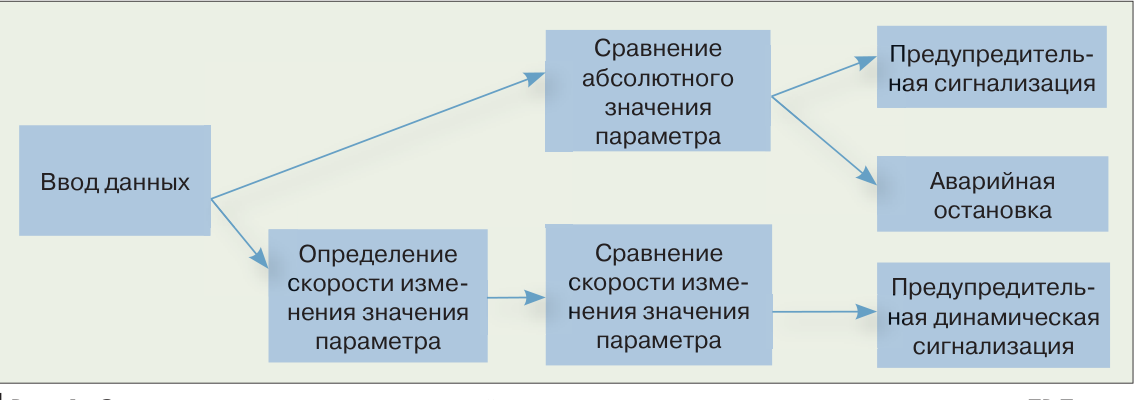
Fig. 1. Structure of the improved system for monitoring gas temperature upstream of the HPT
The system for monitoring gas temperature upstream of the HPT is built on the MIK-51 PLC (Fig. 3) made by Microl LLC (Ivano-Frankivsk). The MIK-51 is a compact, multifunctional industrial microprocessor controller designed for automatic control and logic control of industrial processes.
The controller is programmed with dedicated software — the ALFA visual FBD program editor — or from the front-panel keys. The programming language implemented in the system is Function Block Diagram. The programming system complies with the International Electrotechnical Commission standard IEC 1131-3 and is designed for developing data acquisition and process control application software that runs on programmable controllers.
The MIK-51 processes data and transmits it via Modbus RTU to the BPI-52 interface converter. From there, the data goes over USB 2.0 to a workstation with an OPC server. This makes it possible to analyze the data using different methods and compare the results without spending extra time on synchronizing, processing and transferring data.
Let us look at the function block program (Fig. 2) developed for this task. The following function blocks from the controller library are used: AIN — analog input, CMP — comparator, DOT — digital output, DERIV — differentiation with delay, ABS — absolute value, USER — user panel.
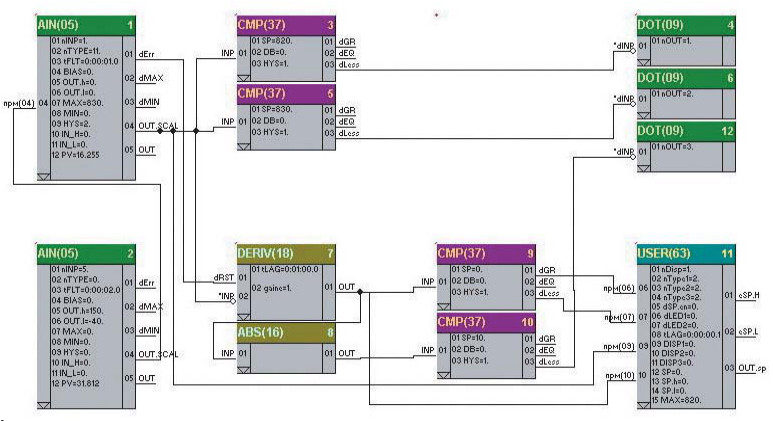
Fig. 2. MIK-51 controller program as function blocks
The AIN blocks (1, 2) process data from the controller's hardware analog inputs and pass it to the user program. AIN (1) outputs a numerical value corresponding to the gas temperature upstream of the high-pressure turbine; AIN (2) outputs a numerical value corresponding to the ambient temperature (used for thermocouple cold-junction compensation). The AIN block has an exponential filter to cut off high-frequency noise, which protects against impulse interference and false emergency shutdowns; the tFLT parameter is the time constant of the exponential filter. The AIN block also checks signal validity: if the signal goes beyond the scale, the block output keeps the last valid value. In this case, the dErr output of AIN (1) and the indicator on the MIK-51 front panel report an error.
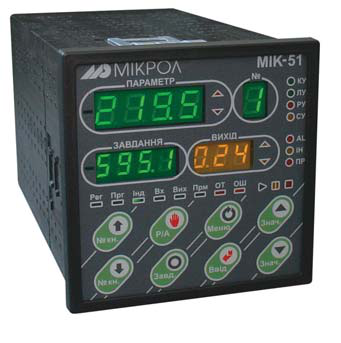
Fig. 3. MIK-51 industrial microprocessor controller
The OUT.SCAL output of AIN (1) is fed to the inputs of CMP (3, 5) and DERIV (7). Comparators CMP (3, 5) handle the static absolute warning and trip setpoints of 820 and 830 °C respectively. Warning and trip signals are sent by digital output blocks DOT (4, 6) to the GCU SCKU, where the corresponding relays PTG (gas temperature warning) and ATG (gas temperature trip) are activated. DERIV (7) determines the rate of change of the parameter.
The rate of temperature change upstream of the HPT is analyzed by comparators CMP (9, 10). CMP (10) sends a command to digital output DOT (12), which signals that the temperature upstream of the HPT is changing faster than the set rate. CMP (9) shows the direction of change. This type of warning alarm is new and lets operating personnel respond promptly to changes in pipeline operating mode. When the pipeline mode changes, the load on the compressor changes, which can cause a rapid change in gas temperature upstream of the HPT. The standard SCKU system issues a warning when the gas temperature upstream of the HPT reaches 820 °C, and operating personnel do not have enough time to reduce gas turbine engine speed before the trip setpoint is reached. Thanks to the additional alarm, the proposed system makes it possible to avoid a GCU emergency shutdown in such a situation. The USER block (11) displays the current gas temperature upstream of the HPT and its rate of change over the last minute on the controller front panel, and its LEDs show the state of the protection channels and the direction of change.
The system is currently in trial operation on GCU No. 3 of compressor shop No. 2 at the Dolyna compressor station, Dolyna Line Production Department of Main Gas Pipelines (Prykarpattransgaz). During operation it has proved reliable and functional. Fig. 4 shows a photo of SCADA screen trends. During a planned GCU shutdown at 15:29, a mild compressor surge occurred, and the gas temperature upstream of the HPT rose sharply at 40 °C/min. The system issued the warning "Gas temperature rise rate upstream of HPT exceeded", the shift engineer reduced the speed and thereby stopped any further temperature rise.
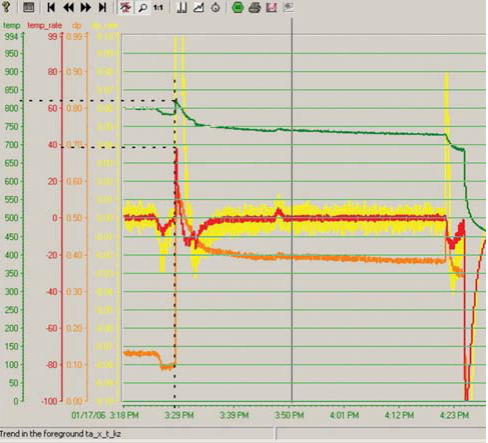
Fig. 4. SCADA system trends during a GCU shutdown
In future, the results of this research can be applied to other processes with similar process parameter behavior.
As a result of this work, a system for monitoring gas temperature upstream of the high-pressure turbine of GTK (GTNR)-10 GCUs has been created, with a new hardware-implemented function for monitoring temperature dynamics. The system outperforms the existing one in the following respects: the basic reduced error is 0.2 instead of 0.5, and the response time has been cut from 1 s to 0.1 s. The system has become more informative thanks to the added analytical parameter "rate of temperature change" and its connection to the compressor station process control system.
For more information about the products mentioned in this article, please contact Microl LLC:
+38 (0342) 502-701
+38 (067) 359-70-90
+38 (095) 092-07-28
sale@microl.ua, microl_zbut@microl.ua, zbutmicrol@gmail.com
www.microl.ua
Technical support:
+38 (0342) 502-702
+38 (067) 704-00-29
+38 (095) 302-37-57
support@microl.ua, supmicrol@gmail.com
Originally published in Mir Avtomatizatsii (World of Automation) magazine, April 2008.
Open the booklet / download PDF