







Archive
16.11.2026


 0
 0
 Touch operator panels Weintek
 Meters-indicators
 Controllers (PID, ON/OFF)
 I/O modules

I/O modules
 Spark protection barrier

Spark protection barrier
 Recorders and archivers

Recorders and archivers
 Meters and converters of electrical network parameters

Meters and converters of electrical network parameters
 Counters, timers, tachometers

Counters, timers, tachometers
 Liquid level indicators and regulators

Liquid level indicators and regulators
 Programmed logical controllers

Programmed logical controllers
 Manual signal transmitters

Manual signal transmitters
 Technological signaling devices

Technological signaling devices
 Power supplies

Power supplies
Codesys PLC controllers
Codesys PLC controllers
 Normalizing converters

Normalizing converters
Galvanic isolation and branching blocks
Galvanic isolation and branching blocks
 Communication interface converters and amplifiers

Communication interface converters and amplifiers
 Analytical instruments

Analytical instruments
 Switching blocks

Switching blocks
Control and protection units
Control and protection units
 GSM communication routers / modems

GSM communication routers / modems
Archive
16.11.2026
Author
V. B. Onufryk, Microl LLC, E-mail: support@microl.ua
V. V. Dykhnilkin, Microl LLC, E-mail: asutp@microl.ua
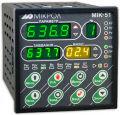
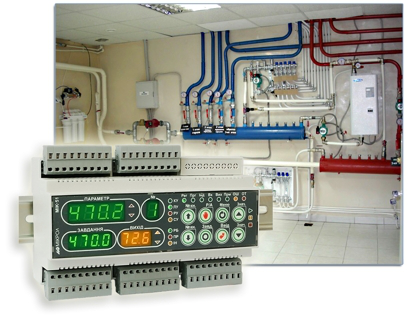
This article looks at one possible way of automating the units of a boiler plant, which, on the one hand, is an integral part of any enterprise and, on the other, offers wide scope for improving efficiency and cutting costs. For stable and economical operation of heating and hot water systems, Microl LLC (Ivano-Frankivsk) offers to automate them with the MIK-51N controller.
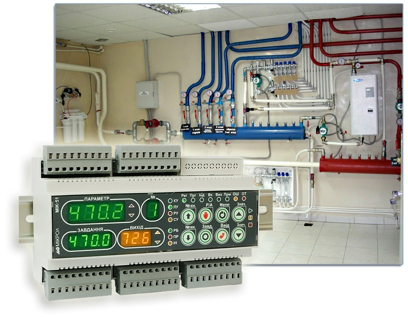
The MIK-51N controller handles not only the main control tasks (in particular, temperature control in the heating and hot water loops) but also protects the system against excessive return water temperature, operates in two modes (night and day) and logs data to a PC. The functional diagram is shown in Fig. 1. The MIK-51N provides:
The heating curve and the return water curve are shown in Fig. 2.
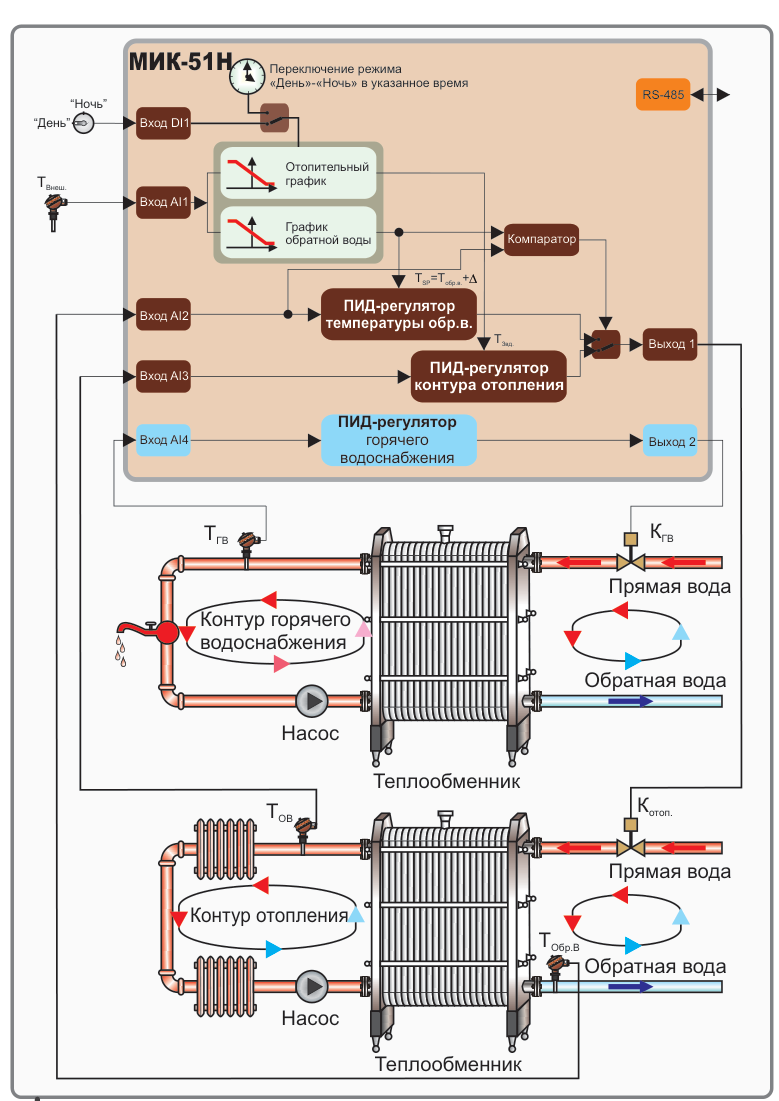
Fig. 1. Automation diagram
The heating loop works as follows. The signal from the outdoor air temperature sensor is fed to the controller's first analog input. Based on this value and the user-defined heating curve, the controller generates the heat-carrier temperature setpoint for the heating system controller. The controller output can be either analog or pulse (depending on the actuator installed). This signal sets the position of the heat-carrier control valve. Changes in outdoor temperature change the controller setpoint.
For better control, setpoint balancing is provided. At a set time, for example after the end of the working day, the heating curve automatically switches to "Night" mode. In this mode, the temperature setpoint from the heating curve is lower than in day mode.
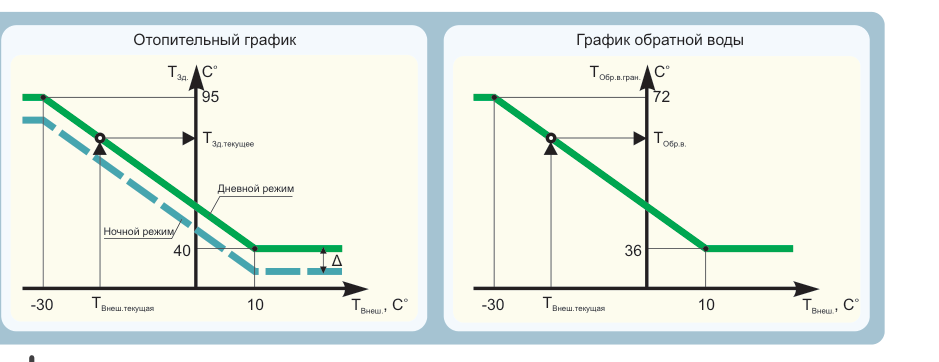
Fig. 2. Heating curve and return water curve
Economic efficiency can also be achieved by monitoring the return water temperature. The controller compares the maximum permissible temperature from the return water curve (depending on outdoor temperature) with the actual return water temperature. If the temperature is within the permissible range, the heat-carrier valve is controlled by the heating system controller. As soon as the return water temperature exceeds the permissible value (i.e. heat is not being given off to the heating loop), control of the valve passes to the return water controller until the temperature returns to normal.
The hot water loop is controlled by a PID controller that maintains the set temperature in the hot water system.
Using the Visual Intellect SCADA system (developed by Microl LLC) on operator PCs provides full remote control of the plant.
For more information about the products mentioned in this article, please contact Microl LLC:
+38 (0342) 502-701
+38 (067) 359-70-90
+38 (095) 092-07-28
sale@microl.ua, microl_zbut@microl.ua, zbutmicrol@gmail.com
www.microl.ua
Technical support:
+38 (0342) 502-702
+38 (067) 704-00-29
+38 (095) 302-37-57
support@microl.ua, supmicrol@gmail.com
Originally published in May 2009.
Open the booklet / download PDF